


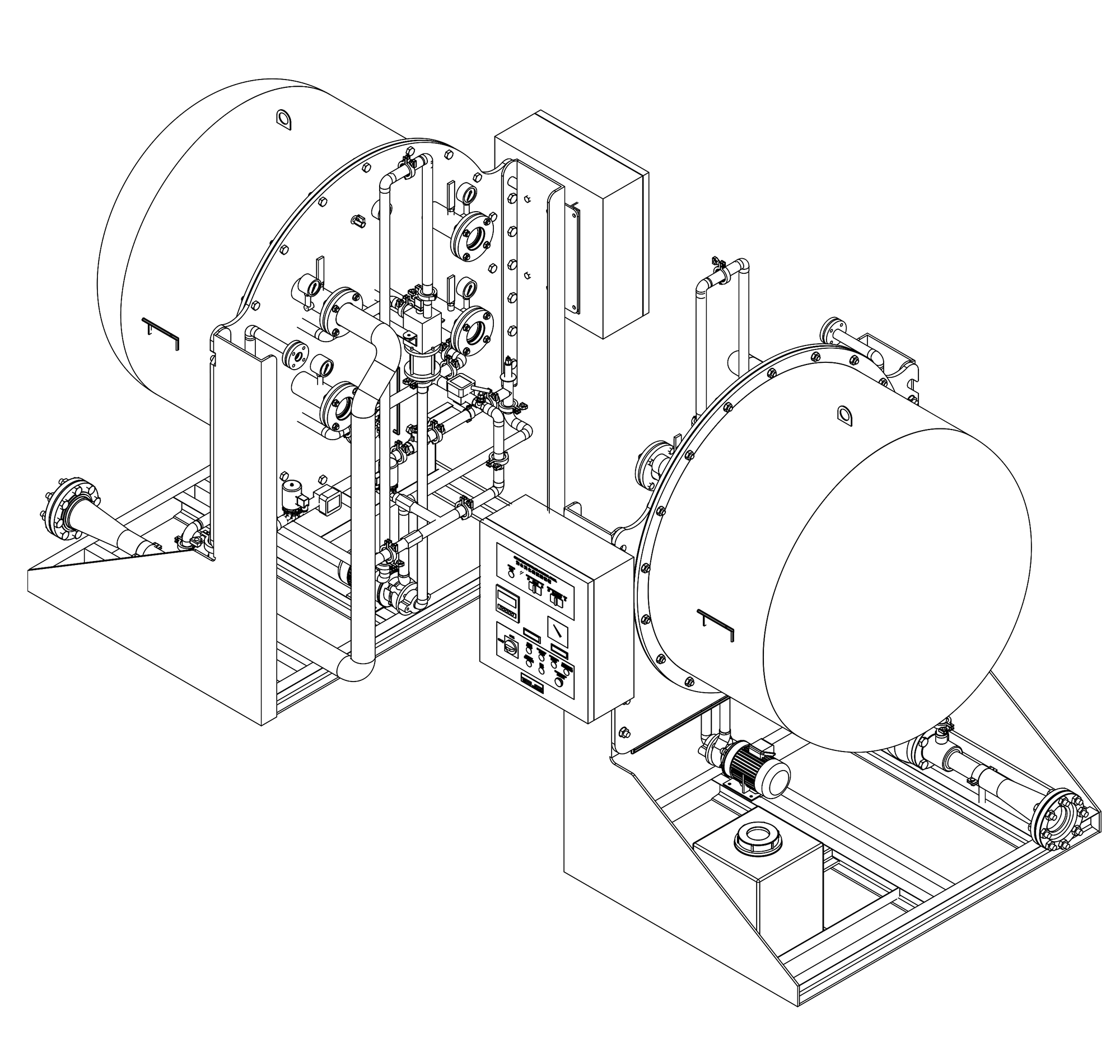


Seawater desalination via vacuum
freshwater vacuum distiller

technical water from waste heat. engineered for versatility; built for longevity.
Ensure water production is a strength in your vessel's operational profile. VVD Series vacuum distillers safeguard your vessel's water security, producing high-quality technical-grade freshwater from the harshest seawater or high-silt brackish waters — all while using the energy your ship is already producing.
Process
Vacuum distillation, thermal phase change
Construction
Titanium or cupro-nickel alloys
Capacity range
3 – 60 m³/day
a superior solution
VVD Series vacuum distillers are source-water agnostic, maintaining peak operational efficiency regardless of temperature swings, high turbidity or varying salinity levels. Relying on thermal phase change instead of microscopic physical filtration, the system bypasses the limitations of fragile membranes — cleanly separating pure distillate while isolating all dissolved and suspended solids, including silt, sand and salts, within the boiling chamber.

key technical specifications
Built to endure the realities of the engine room, VVD Series distillers combine heavy-duty metal fabrication with intelligent design.
Materials
Titanium
or cupro-nickel alloys, chosen to resist hot, concentrated seawater brine
Control
Advanced PLC
automated start-up and continuous salinity monitoring
Frame
Skid-mounted
optimised for tight spaces, new-build and retrofit
automatic intelligence & fail-safe operations
Managing an auxiliary system shouldn't add to your crew's workload. The VVD Series incorporates a smart PLC system managing all critical parameters, putting total control at your fingertips.
Capacity range
3–60 m³/day
Boiling point under vacuum
40–50 °C
Operating under vacuum, the boiling point of the incoming feed water is drastically lowered — often to between 40 °C and 50 °C — allowing the system to run on low-grade waste heat already available onboard.
Main features
- Thermal phase-change distillation — no fragile membranes
- Boiling chamber, heat exchangers and associated piping in titanium or cupro-nickel alloys
- Titanium evaporator and condenser plate stacks
- Advanced PLC with automated start-up and continuous distillate salinity monitoring
- Automatic overboard dump if salinity exceeds a set threshold
- Compact skid-mounted frame for new-build integration and retrofit installation
Main advantages
- Source-water agnostic — unaffected by temperature swings, turbidity or salinity
- Distillate with extremely low TDS, often below 5 ppm
- Runs on low-grade waste heat, such as main engine jacket cooling water
- Silt, sand and salts are isolated within the boiling chamber
- Robust, low-maintenance mechanical components
- No costly, labour-intensive replacement of fragile components
reliable, consistent freshwater production
Thermal distillation produces distillate with extremely low Total Dissolved Solids, making it ideal for sensitive applications like high-pressure boiler feed water, where scaling must be absolutely prevented.
Freshwater quality — TDS
Often < 5 ppm
Feed water
Seawater, turbid & brackish
Unlike technologies that bind or foul in turbid coastal waters, estuaries or areas with high biological content, a vacuum distiller is immune to the physical quality of the feed water — it boils what it takes in.
Read more on VVD Series specifications →how it works
From waste heat to technical-grade freshwater — how the VVD Series distils seawater onboard.


Built for the engine room
marine-grade construction
The boiling chamber, heat exchangers and associated piping are fabricated from premium titanium or cupro-nickel alloys, specifically chosen to resist the aggressive corrosion of hot, highly concentrated seawater brine.

Engineered for versatility; built for longevity.
energy efficiency redefined
Operating under vacuum lets the VVD Series utilise low-grade waste heat that is already available onboard. Whether harnessing thermal energy from the ship's main engine jacket cooling water or alternative heat sources, the distiller continuously vaporises seawater with exceptional energy efficiency.
Confirm heat-source integration for your vessel and selected model with our engineering team.

minimal capex
Negate the costly and labour-intensive routine of replacing sensitive, fragile components present in other technologies. The VVD Series operates with robust, low-maintenance mechanical components.

Robust, low-maintenance mechanical components for long-term reliability at sea.
freshwater vacuum distiller
Full technical specifications and model range for the VVD Series Freshwater Vacuum Distiller.
model range
| Model | VVDS-T5 | VVDS-T10 | VVDS-T15 | VVDS-T20 | VVDS-T30 | VVDS-T40 | VVDS-T50 |
|---|---|---|---|---|---|---|---|
| Capacity (m³/day) | 3–5 | 8–12 | 12–17 | 17–22 | 28–36 | 40–48 | 50–60 |
| Evaporator plate stack | Titanium | ||||||
| Condenser plate stack | Titanium | ||||||
| Supply voltage | According to customer requirements | ||||||
| Freshwater salinity | < 10 | < 10 | < 10 | < 10 | < 10 | < 10 | < 10 |
Parameters of production freshwater vacuum distillers. Confirm exact figures for your selected model with our engineering team.

technical specifications
Process
Vacuum distillation — thermal phase change
Water produced
High-quality technical-grade freshwater
Feed water
Seawater, high-silt brackish water, turbid coastal waters
Capacity range
3 – 60 m³/day
Distillate quality
Extremely low TDS, often below 5 ppm
Boiling point under vacuum
Often 40 – 50 °C
Heat source
Low-grade waste heat — main engine jacket cooling water or alternative heat sources
Boiling chamber, heat exchangers & piping
Titanium or cupro-nickel alloys
Evaporator & condenser plate stacks
Titanium
Control system
Advanced PLC — automated start-up, continuous distillate salinity monitoring, automatic overboard dump
Frame
Skid-mounted, for new-build and retrofit installation
Supply voltage
According to customer requirements
documentation & enquiries
Product reference
Voyagaer Auxiliary Equipment — VVD Series
Brochure
Sales enquiries